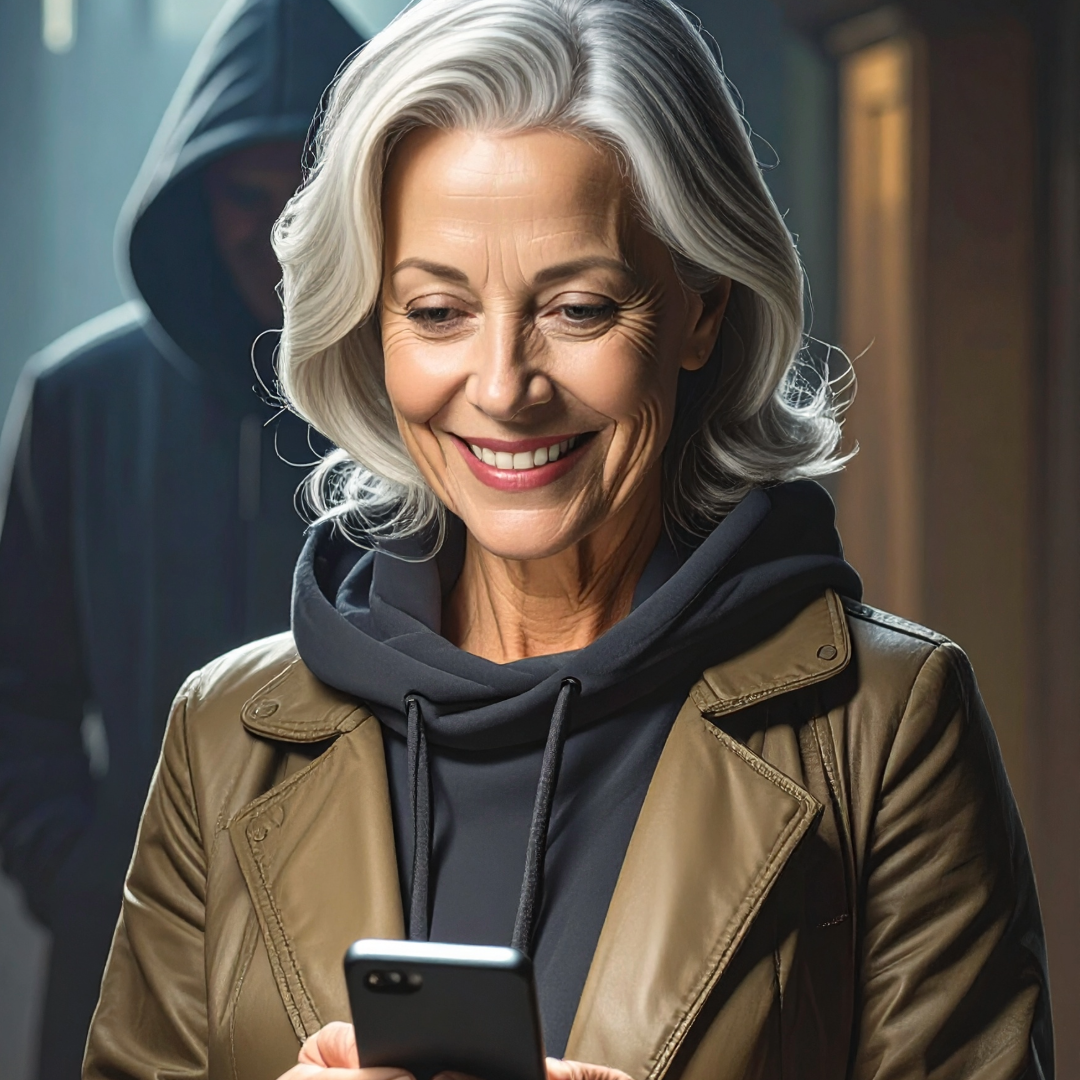
Michelle has been a widow now for several years. Only in her mid-fifties, she felt that she should have a chance at love again. She lost her partner when they were only 42. At that time, she vowed to never love another again — but felt that maybe the time was right to move on.
She started looking at online dating sites aimed at people of her age. She soon found one where you can create a profile and read messages from others, but can't reply unless you pay for a subscription. She figured she might as well pay. What was the point otherwise?
Every day, she would open the app and scroll through her options. She would choose "Yes" for some and "No" for others. Very quickly she started to get a few matches, and they would begin chatting. Eventually, one had her full attention. His name was Salvatore — an Italian immigrant, warm and well-read. They had both loved the same books. They shared a love for the Beatles.
After a few days back and forth, Salvatore asked that they move to another app where their conversations would be private. Michelle understood. They both joked about what the moderators must read all day.
"Imagine what goes on in some of those conversations!"
They moved over to WhatsApp. Michelle hid her dating profile. She was enjoying her time with Salvatore and wanted to see where it led. She didn't tell her family — she was already embarrassed enough about being on a dating app.
After a few short weeks, she started to grow fond of him. He would proclaim how happy he was to have found her — and he was writing songs for her. He would send recordings of himself playing guitar: original compositions about her, and his own covers of the Beatles songs she loved. She loved his versions of Blackbird and Hey Jude.
Soon he declared his love. He knew he had found the right companion to spend the rest of his life with. He talked about savings he had, about taking a series of cruises around the world together, staying at the finest resorts. He would pay for everything.
She was taken aback. She hadn't thought she would find love again — but she was feeling a real connection. She considered his offer, but said she needed more time. She still hadn't even spoken to him on a real phone call.
He said he was very shy. He wanted to talk to her but was afraid he would stutter and she wouldn't want to be with him. He told her about a rough childhood — how his stutter had cost him relationship after relationship. That it wasn't until he discovered online dating that love felt within reach. He would call her soon. Just not yet.
They carried on chatting. Salvatore kept sending new recordings of himself singing songs for her. Michelle was falling in love with him. There was no doubt.
A few weeks later, Salvatore came on the chat suddenly:
"Michelle, are you there? Michelle?! I need to talk to you. Something bad has happened."
"This is Salvatore's friend Paolo. He has been in an accident. He fell. He was rushed to hospital and is having trouble concentrating — a bad headache, some bruises. He's going to be okay, but the hospital won't treat him without a deposit. There's a problem with his insurance. He asked me to reach out to you. He was so ashamed, but he's desperate. He can reimburse you right away."
The message included a voice clip. Salvatore, very weakly, singing Blackbird. It was heartbreaking.
She immediately asked what she could do. Paolo said the hospital accepted cryptocurrency. She could find a Bitcoin ATM on Google Maps and send the funds to a wallet number he would provide. He broke down the costs: the CT scan was $3,280, a suspected broken arm another $4,000 to $7,000. They didn't need the full amount up front — just a deposit of $3,000.
She got the wallet address. She found a Bitcoin ATM a few blocks away. She walked over and followed the instructions on the screen.
A few days later, Salvatore was home and back online. He was upset he couldn't play guitar during his recovery. He was still fighting with his insurance company. He promised he would get her money back as soon as his broker returned from overseas — just a few more weeks.
The next day, his family doctor wanted more tests. Another scan. A private clinic this time — and this one required the full amount upfront. $1,520. With his insurance still unresolved, he asked Michelle again.
She thought about her own savings. What she had left for emergencies. Her house was paid for, thankfully. Her pension covered a simple life — but that was all. She reluctantly agreed. He promised it would all come back to her the moment his broker landed.
Like the hospital, the clinic also accepted cryptocurrency only. She found herself wondering: Is this really just how things work in the US now?
She went back to the Bitcoin ATM.
She reached out the next day. Heard nothing. Then the day after. Nothing. It was so unlike him — he had never gone three hours without messaging her, let alone a full day. Her mind raced. What if the fracture had been worse than they thought? What if he was unconscious?
She almost got in her car and drove to the border — only minutes away — before realizing she didn't know his address. Or the hospital. Or Paolo's phone number. She had nothing.
No message ever came again.
A few months passed. Michelle was sitting with her friend Carol over coffee and found herself opening up about Salvatore for the first time. She told her everything — how they met, the songs he sang for her, the plans they had made. When she finally finished, Carol set down her cup and was quiet for a moment.
"How much do you actually know about him?" Carol asked carefully. "Have you ever seen him in person? Spoken to him on a real phone call?"
"We talked every day," Michelle said. "He sent me recordings, voice messages—"
"But never a real call."
Michelle hesitated. "He had a stutter. He was embarrassed about it."
Carol reached across the table and took her hand. "And the money — after the accident. How did he ask you to send it?"
"Cryptocurrency," Michelle said. "To the hospital's wallet. Then again to a private clinic."
Carol held her hand a little tighter. "Michelle." She paused. "Did you ever tell Salvatore that you didn't have any more money?"
The silence that followed lasted a long time. Michelle stared at her coffee cup. Something was shifting behind her eyes.
"Oh God."
Michelle lost $4,520. Salvatore never existed.
Romance Scams: What to Watch For
Romance scams are among the most devastating frauds targeting older adults — not because the victims are foolish, but because the scammers are exceptionally skilled. They are patient, emotionally intelligent, and deliberate.
Michelle's story is not rare. It is happening right now, in every province, to people who are sharp, careful, and simply wanted companionship.
- They move you off the dating platform quickly — to WhatsApp or another private app
- They never agree to a live video or real phone call — there's always an excuse
- They declare love unusually fast and make grand future plans
- A crisis appears that requires you to send money — urgently
- They ask for cryptocurrency, wire transfers, or gift cards — never traceable methods
- They vanish the moment you say you have no more money
Get the Free Scam Alert Newsletter
Join thousands of Canadians receiving scam warnings, awareness tips, and updates about the book — delivered straight to your inbox. No spam. Ever.
No spam. No selling your info. See our privacy promise →